Blog
There is a kind of therapy that gently invites you to pause.
To breathe.
And to remember – you are here. And that is enough.
“Cotton Candy” is a series of soft thoughts and reflections from the world of psychotherapy.
They are small, gentle, and true.
Meant for those who are searching for themselves – not through suffering, but through presence.
Welcome to Volume 1.
Author: Svetlana Vuković

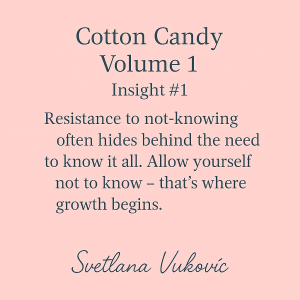
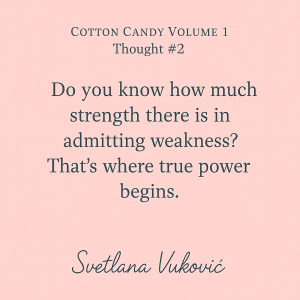
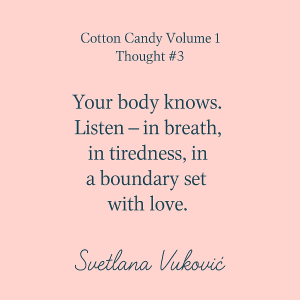


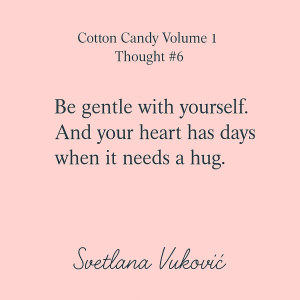

From the upcoming book: *How You Communicate Is How You Live*
by Svetlana Vuković
This excerpt is part of my book-in-progress –
How You Communicate Is How You Live: A Practicum for Everyday Clarity.*
In this book, I explore how our tone, silence, words, and presence shape not only our relationships – but the very quality of our lives.
The book will soon be available for download on this site, in English, Serbian, and French.
Until then, here is a chapter that speaks to something we’ve all felt – the fragile space between distance and connection, in the middle of everyday conversations.
A Small Guide to Difficult Conversations (Arguments and Misunderstandings)
Saturday afternoon, lunchtime. She’s setting the table, exhausted, feeling a burning in her chest:
“Can’t you at least put the plates on the table? I went to the market, cooked, cleaned the house, and you just walked in from tennis asking if lunch is ready!”
He, smiling, not noticing the weight in her voice, replies:
“Oh, you’re nagging again. Didn’t you hear me say I beat Rade 3–0? It was great, and then we had a beer in the shade.”
She angrily slams the plates on the table. He leans back, talking about the match. Each is lost in their own thoughts. Though sitting at the same table, they’re far from each other. On the verge – either of a fight, or of connection.
Maybe you’ve had a similar experience. Maybe you’ve felt how a conversation, instead of bringing closeness, only deepens the loneliness. How neither you nor your partner truly feel heard or seen – because each is waiting for their part to be acknowledged, forgetting to see the other.
From this moment, the scene can unfold in two directions.
In the first, silence continues – not as a space of connection, but as a wall. After lunch, he scrolls through his phone, laughing alone at clips. She goes to another room and quietly vents to a friend. Each remains with their own sense of injustice, misunderstanding, and solitude. A weekend that could have been an opportunity for connection becomes a quiet struggle for personal validation.
In the second, after a moment of silence, she looks at him and with a gentle smile says:
“Come on, tell me how Rade lost today – he usually beats you. I’m all ears.”
He looks at her, sensing her gesture, lowers his pride, smiles and says:
“Sorry. I was a bit selfish today. After a hard week at work, all I wanted was to escape. Thank you for the lovely lunch and the peace you gave me. And about Rade… well, he had a leg injury, otherwise I’d never have beaten him.”
They both laugh, their eyes meet. The atmosphere changes. Instead of a wall, there’s a bridge. They continue lunch in a gentle exchange, laughing together, making small plans for the rest of the weekend – together, present for one another.
In every encounter, we have a choice. Not to be perfect. But to be present enough to recognize when a conversation starts drifting into conflict. When one of the two realizes that this path won’t lead to anything good and decides to “lower the ball,” to step away from the fight – everything changes. The body relaxes, the gaze softens, and the space between them becomes lighter, more breathable. Not because someone won, but because preserving the relationship became more important than proving a point.
Svetlana Vuković, Gestalt Psychotherapist & Supervisor
Author of the upcoming book “How You Communicate Is How You Live”

